Is Your Business Ready to Grow Digitally? Take This Free Audit
 By
By
Before You Spend Another Baht on Marketing, Read This
Most business owners in Southeast Asia who are frustrated with their digital marketing results share one common characteristic: they have been investing in the visible parts of marketing ,social media posts, boosted ads, a website refresh ,without ever assessing whether the underlying infrastructure is actually ready to support growth.
Digital marketing is not just about the content you produce or the budget you spend. It is about whether the system beneath all of that ,the lead capture, the follow-up, the tracking, the nurturing ,is functioning well enough to convert the attention you generate into actual customers. A business with weak digital infrastructure can spend a significant budget on advertising and see almost nothing in return. The same business with solid infrastructure often sees dramatic results from a much smaller investment.
This post is a self-audit ,a structured way for you to assess the current state of your digital setup across the five areas that matter most to business growth. For each area, you will work through a short checklist and score yourself honestly. At the end, you will have a total score that tells you clearly which category you fall into, what your most important priorities are right now, and what the logical next steps look like for your specific situation.
There are no right or wrong answers here. The goal is clarity ,an honest picture of where you are so you can make better decisions about where to invest your time and money next.
How to Use This Audit
This audit covers five areas: your website, your lead capture system, your follow-up process, your content strategy, and your analytics. Each area has a checklist of five statements. For each statement, assign yourself a score from 0 to 2 based on how accurately it describes your current situation.
- 2 points:
This is fully in place and working well right now.
- 1 point:
This exists in some form but is incomplete, inconsistent, or not working as well as it should.
- 0 points:
This does not exist or has never been set up.
Be honest. Generous scoring does not help you ,it just delays the clarity you came here for. Each area has a maximum of 10 points, giving a total maximum score of 50 across all five areas.
Area 1: Your Website ,The Digital Foundation (Max 10 points)
Your website is the hub of your digital presence. Every other channel ,social media, advertising, email, referrals ,should ultimately direct people to your website, where they can learn more about you, trust you, and take an action. A website that cannot do those three things efficiently is costing you leads every single day.
The checklist
- My website loads in under 3 seconds on a mobile phone.
In Southeast Asia, where the majority of users access the internet on smartphones ,often on 4G connections with variable speeds ,a slow website is not just an inconvenience, it is a conversion killer. Research from Google consistently shows that 53% of mobile visitors abandon a website that takes more than three seconds to load. Test your website speed at pagespeed.web.dev and score yourself honestly based on the result.
- A visitor who lands on my homepage immediately understands what I do, who I serve, and why they should choose me.
The 'five-second test' is simple: could a stranger, looking at your homepage for five seconds, tell you exactly what your business does and who it is for? Most homepages fail this test because they lead with the business name and a generic tagline rather than a clear, specific value proposition. If your homepage says something like 'Welcome to [Business Name] ,Your Partner in Growth' without immediately explaining what you do and for whom, score yourself 0 on this item.
- My website has at least one clear call to action on every key page.
Every page on your website should direct visitors toward a specific next step ,book a consultation, download a guide, contact us, view our services. A page without a clear call to action is a dead end. Visitors arrive, read (or do not read), and leave without taking any action that benefits your business. Score 2 if every key page has a prominent, specific CTA. Score 1 if some pages do but others do not. Score 0 if your website essentially has no CTAs.
- My website is connected to a tracking tool that shows me how many people visit, which pages they view, and where they come from.
Google Analytics 4 is free, takes 15 minutes to install, and provides everything a small business needs to understand its website traffic. Without it, you are operating your digital marketing completely blind ,making decisions based on assumptions rather than data. If Google Analytics or an equivalent tool is installed and you check it regularly, score 2. If it is installed but you never look at it, score 1. If it is not installed, score 0.
- My website includes social proof ,customer testimonials, case studies, reviews, or logos of brands I have worked with.
In Southeast Asia's trust-driven purchasing culture, social proof is not decorative ,it is essential infrastructure. A buyer who is researching you needs to see evidence that other people have used your service and found it valuable. If you have three or more genuine, specific testimonials prominently displayed on your website, score 2. If you have one or two, score 1. If you have none, score 0.
Area 1 total: _____ / 10
Area 2: Your Lead Capture System ,Turning Visitors Into Contacts (Max 10 points)
A website without a lead capture system is like a shop with no counter ,people can browse, but there is no mechanism for them to indicate interest and no way for you to follow up. Lead capture is the bridge between someone discovering you and you being able to build a relationship with them.
The checklist
- My website has at least one form that captures visitor contact information.
This is the minimum viable lead capture mechanism. A contact form, an inquiry form, a newsletter sign-up ,any form that collects at minimum a name and email address counts. Score 2 if you have a form and it works correctly. Score 1 if you have a form but it goes to a general inbox that is not monitored consistently. Score 0 if your website has no form ,just a phone number or email address listed as text.
- I offer a lead magnet ,a free resource that gives visitors a reason to share their email address.
A lead magnet upgrades your lead capture from passive (waiting for people who are already ready to contact you) to active (capturing people who are interested but not yet ready to commit). A free guide, a checklist, a template, a mini-course, a free consultation ,anything that delivers genuine value in exchange for contact information. If you have a lead magnet that is actively being downloaded, score 2. If you have one but it is barely promoted, score 1. If you have none, score 0.
- When someone submits a form on my website, they automatically receive a response within minutes.
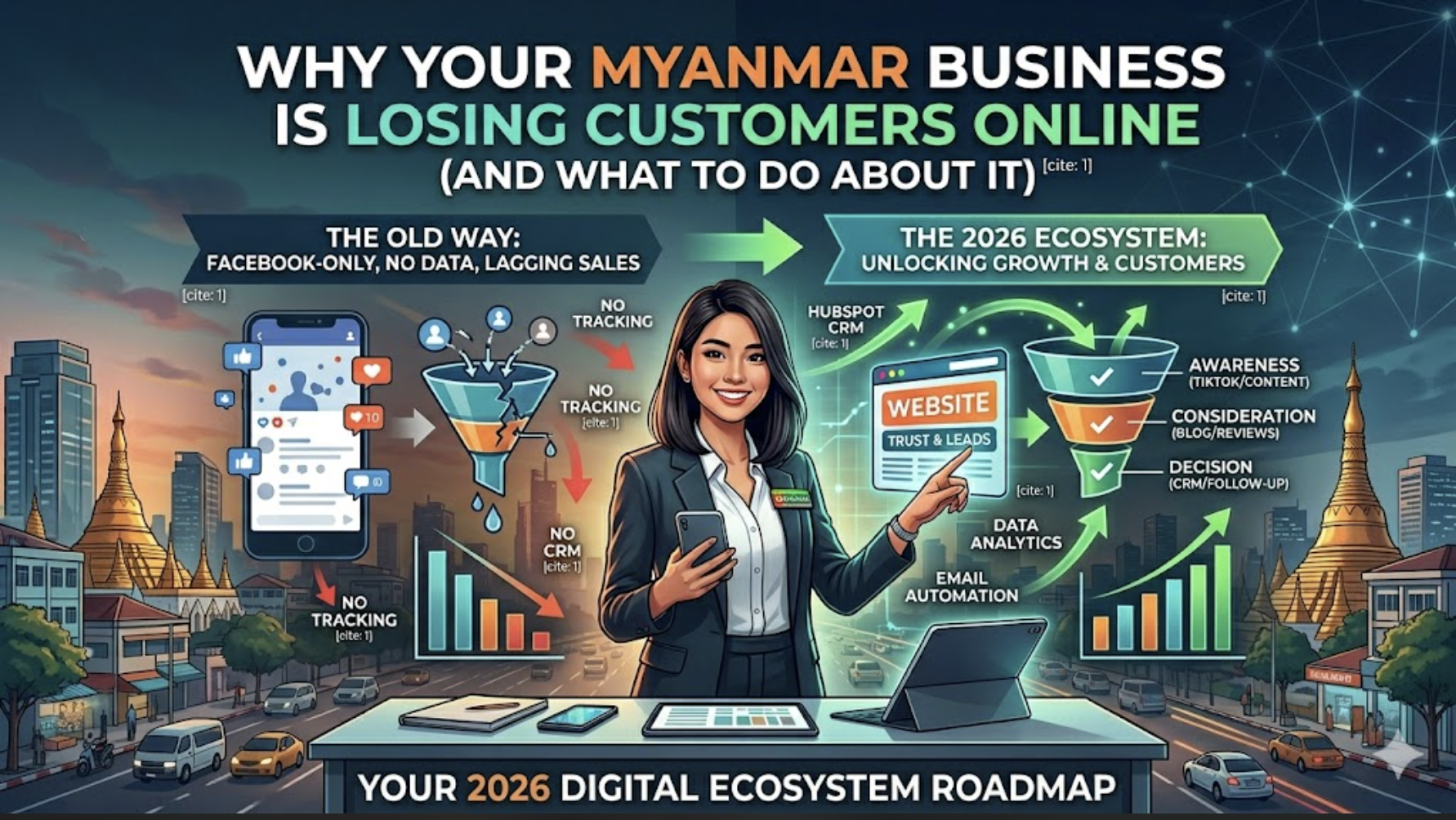
Speed of response is one of the strongest predictors of lead conversion. A contact who fills in your form at 10pm on a Sunday and receives an automated, warm, helpful response within two minutes feels very differently about your business than one who waits until Monday morning. If you have an automated response set up through a tool like HubSpot, score 2. If responses happen manually but within an hour during business hours, score 1. If there is no automatic response and people often wait hours or days, score 0. For more on the impact of response speed on conversion, the Why Your Myanmar Business Is Losing Customers Online post covers this in detail.
- All leads from my website go into a single, organised database ,not scattered across email inboxes, WhatsApp chats, and spreadsheets.
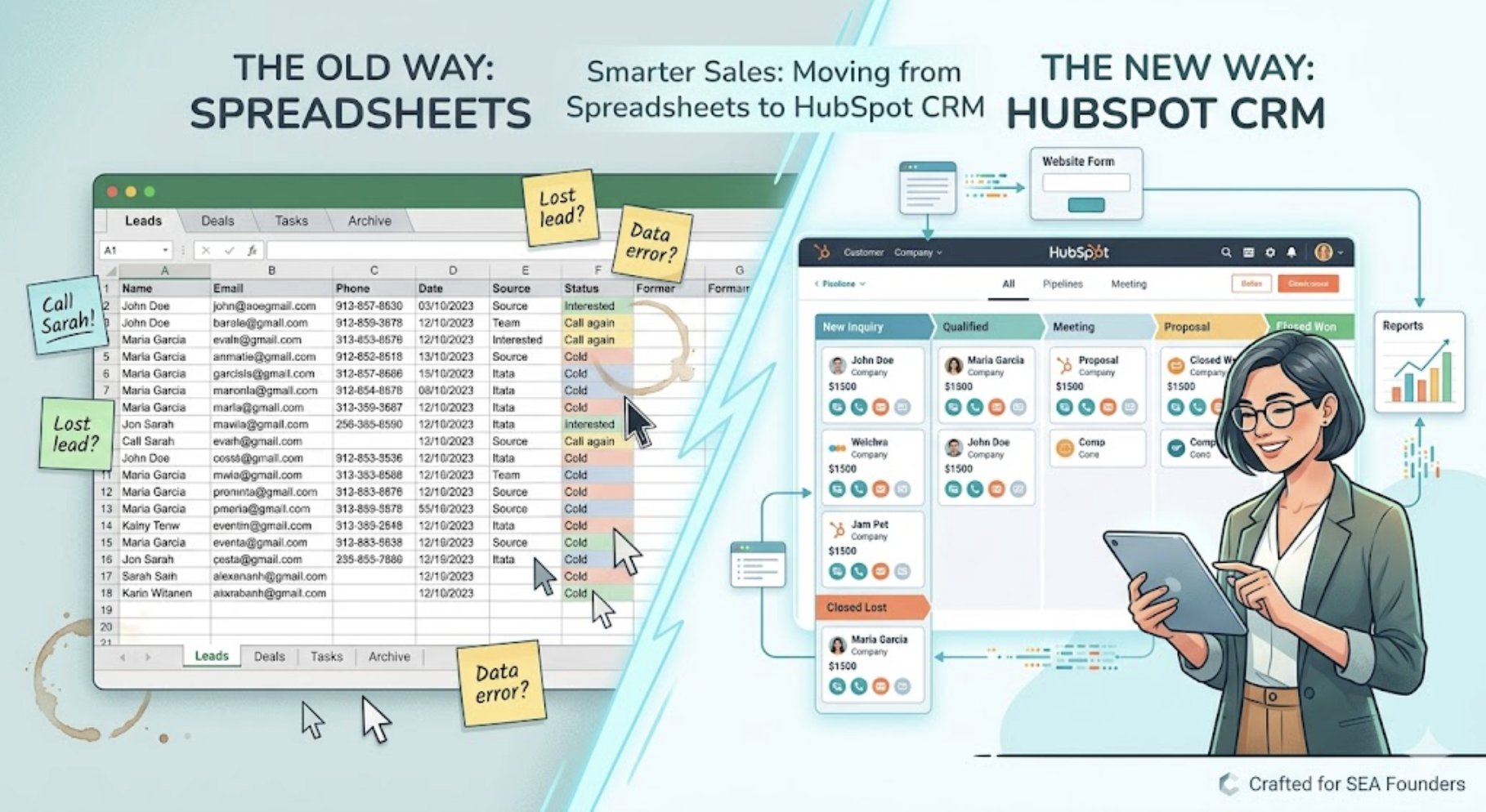
If you cannot answer the question 'how many new leads did I receive last month and where did they come from?' in under two minutes, your lead capture system has a structural problem. A CRM ,even a free one like HubSpot ,solves this by centralising every lead in one place, with source tracking, status management, and contact history. Score 2 if all leads go directly into a CRM. Score 1 if most do but some fall through the cracks. Score 0 if your leads are scattered across multiple platforms with no central record.
- I have a meeting scheduler or booking tool that allows prospects to book time with me without back-and-forth emails.
The friction between a prospect saying 'I would like to talk' and actually booking a call is a significant conversion barrier. Every email exchange required to find a mutually convenient time is an opportunity for the prospect to cool off or find an alternative. A meeting scheduler ,HubSpot's built-in tool, Calendly, or similar ,eliminates this friction entirely. Score 2 if you have one actively promoted on your website. Score 1 if you have one but rarely use it. Score 0 if booking always requires manual scheduling.
Area 2 total: _____ / 10
Area 3: Your Follow-Up Process ,Converting Leads Into Customers (Max 10 points)
Generating leads is only half the job. The follow-up process ,what happens after someone expresses interest but before they buy ,is where most SEA businesses leak the most revenue. A lead that is not followed up consistently is a lead that will almost certainly go to a competitor.
The checklist
- Every new lead I receive gets a personal follow-up within 24 hours ,without exception.
This is the most basic standard of lead management, and it is more commonly violated than business owners like to admit. Busy weeks, high volumes, team holidays ,these are all reasons a lead might wait 48, 72, or 96 hours for a response. Score yourself honestly: not on your best week but on your average week. If every lead gets a personal follow-up within 24 hours consistently, score 2. If it happens most of the time but not always, score 1. If follow-up is sporadic and dependent on memory, score 0.
- I have an automated email sequence that sends a series of helpful, trust-building emails to new leads over the first 1 to 2 weeks.
An automated nurture sequence keeps your business visible to a lead during the consideration phase ,the critical window when they are researching, comparing, and building trust before making a decision. Without a sequence, most leads who do not buy immediately are simply lost. With a sequence, a meaningful percentage of those same leads convert weeks later, at no additional effort cost. Score 2 if you have an active, functioning sequence. Score 1 if you have drafted one but it is not fully set up. Score 0 if you have no automation at all.
- I have a structured pipeline that shows me, at a glance, where every active lead is in my sales process.
A pipeline ,whether in HubSpot, another CRM, or even a well-maintained spreadsheet ,gives you the visibility to manage your sales process proactively rather than reactively. You can see which leads have been sitting in one stage too long, which ones are approaching a decision, and which ones need a nudge. Without a pipeline, you are managing from memory ,and memory is unreliable at scale. Score 2 if you have a pipeline with defined stages that your team updates consistently. Score 1 if you have something but it is inconsistently maintained. Score 0 if you have no structured pipeline.
- When a lead goes cold ,no response for 30 or more days ,I have a system or process to re-engage them.
A cold lead is not necessarily a lost lead. Research consistently shows that a meaningful percentage of leads who went silent eventually buy ,but only from businesses that stayed in contact. A re-engagement sequence ,two or three emails sent automatically to leads who have been quiet for 30 to 60 days ,costs almost nothing to set up and regularly recovers leads that would otherwise be written off. Score 2 if you have an automated re-engagement process. Score 1 if you manually attempt re-engagement occasionally. Score 0 if cold leads are simply never contacted again.
- My existing customers receive structured communication after the sale ,onboarding emails, check-ins, or upsell offers ,not just ad-hoc contact.
Your existing customers are your most valuable marketing asset. They already trust you, they have already experienced your work, and they are statistically far more likely to buy from you again than a new lead is to buy for the first time. A post-sale communication sequence ,even just three emails over the first month ,dramatically improves customer retention and increases the likelihood of referrals. Score 2 if you have structured post-sale communication in place. Score 1 if you follow up with customers sometimes but inconsistently. Score 0 if the relationship effectively ends at the point of sale.
Area 3 total: _____ / 10
Area 4: Your Content Strategy ,Building Authority and Attracting the Right People (Max 10 points)
Content is how you build trust before someone contacts you. It is what makes a stranger decide you are worth reaching out to. In a digital environment where buyers research extensively before committing, businesses with strong content attract better leads, close them faster, and build stronger long-term relationships. Businesses without content are invisible to everyone who has not already heard of them through word of mouth.
The checklist
- I publish at least one piece of new content every two weeks ,a blog post, a detailed social media post, a video, or a guide.
Consistency matters more than volume in content marketing. Publishing one genuinely useful piece of content every two weeks builds a library of valuable resources that attracts organic traffic, builds trust, and demonstrates expertise over time. Sporadic publishing ,five posts in one week and then nothing for a month ,produces poor results because algorithms and audiences both reward consistency. Score 2 if you publish consistently at this cadence or higher. Score 1 if you publish sometimes but inconsistently. Score 0 if content creation is largely absent from your business.
- My content directly addresses the specific questions, problems, and concerns of my target customers ,not just general topics related to my industry.
Generic content attracts generic audiences. The most effective content for a small business is hyper-specific ,written for the exact person you want to reach, addressing the exact concerns they have before buying. A real estate agent targeting Myanmar buyers in Bangkok who writes a guide called 'How Myanmar Nationals Can Legally Own Condos in Bangkok' will generate dramatically more qualified leads from that post than from a generic 'Bangkok Real Estate Guide.' Score yourself on specificity, not just volume.
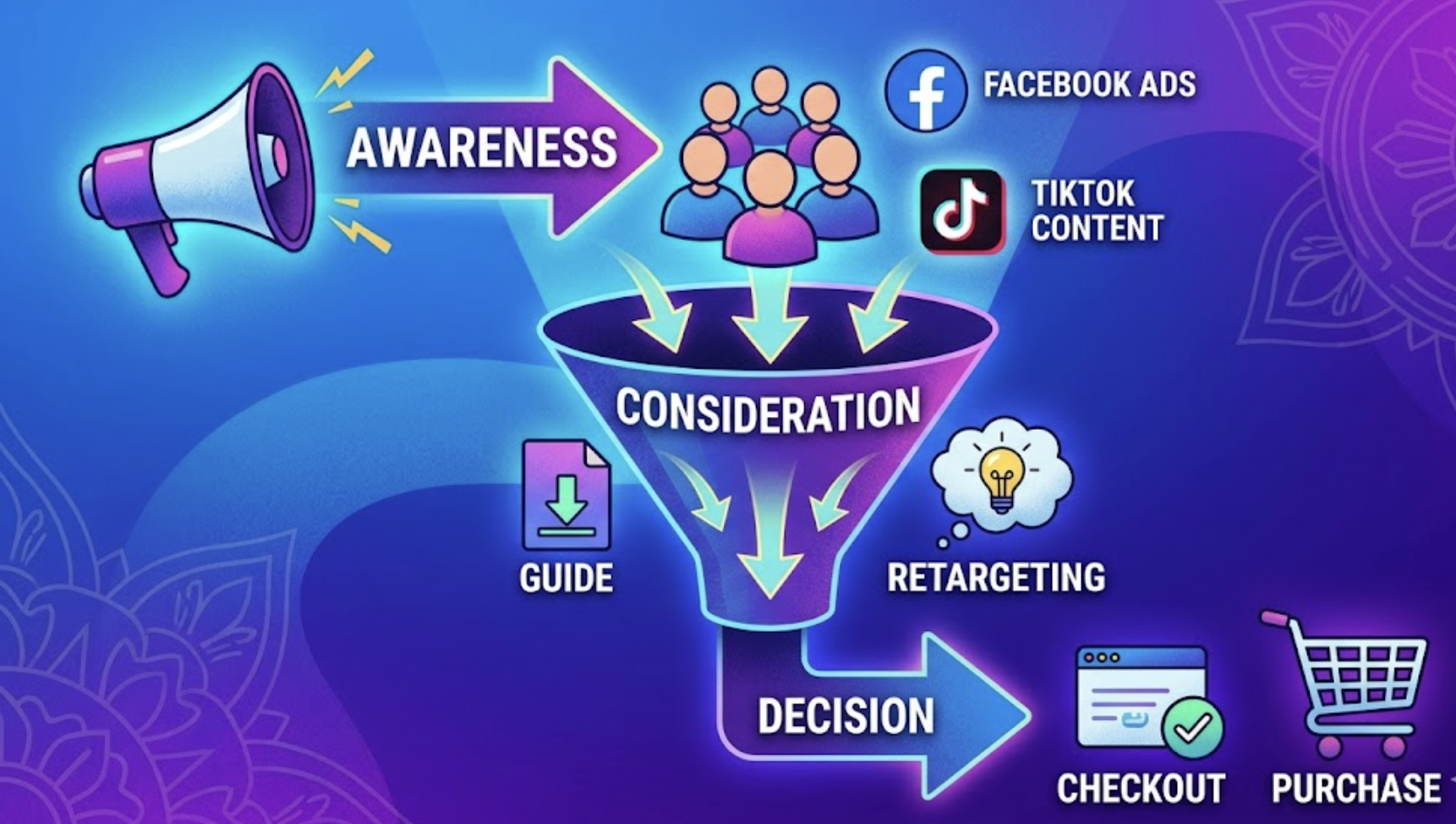
- I produce content for all three stages of the buyer journey ,awareness content that attracts new visitors, consideration content that builds trust, and decision content that drives action.
Most businesses produce content for only one or two funnel stages ,usually awareness (general industry posts) and decision (product/service announcements). The consideration stage ,detailed guides, case studies, comparisons, behind-the-scenes content ,is consistently underserved, yet it is the stage that does the most work in moving someone from interested to committed. The Simple Marketing Funnel post covers exactly how to structure content across all three stages. Score 2 if you have content serving all three stages. Score 1 if you have two. Score 0 if you have only one or none.
- My content is optimised for search ,I research keywords, write descriptive titles, and include meta descriptions on my web pages and blog posts.
SEO does not require a technical background or an expensive specialist. At its most basic, it means writing content about topics people are actively searching for, using the language they use when they search, and providing the most helpful answer to their question. A blog post titled 'How to Register a Business in Thailand as a Myanmar National' will be found by exactly the right person ,if it is written with that search intent in mind and has a proper meta description. Score yourself honestly on whether search optimisation is part of your content creation process.
- I have a content plan or calendar for the next 30 days ,I know what I am publishing, when, and on which platform.
Planned content is almost always better than reactive content. A content calendar does not have to be sophisticated ,a simple spreadsheet listing titles, formats, and publishing dates is sufficient. What matters is that you have made deliberate decisions about what your audience needs to read and when they will receive it, rather than scrambling for ideas at the last minute. Score 2 if you have a plan and follow it. Score 1 if you plan loosely but often deviate. Score 0 if content is entirely reactive.
Area 4 total: _____ / 10
Area 5: Your Analytics and Measurement ,Knowing What Is Working (Max 10 points)
You cannot improve what you do not measure. Analytics is not about drowning in data ,it is about having just enough visibility to make better decisions than your competitors. Most SEA businesses either measure nothing or measure the wrong things. This section assesses whether your measurement infrastructure supports the business decisions you need to make.
The checklist
- I know exactly where my current customers came from ,which channel, platform, or referral source brought them to me.
This is the most foundational marketing question, and most business owners cannot answer it accurately. If you know that 40% of your customers found you through Google, 30% through Facebook referrals, and 30% through word of mouth, you have clear guidance on where to invest your marketing energy. Without this knowledge, you are distributing your budget equally across all channels regardless of actual performance. Score 2 if you have clear data on this. Score 1 if you have a rough sense but no hard data. Score 0 if you genuinely do not know.
- I track key conversion metrics ,how many visitors become leads, how many leads become customers, and what my average cost per acquisition is.
Conversion metrics tell you the efficiency of your marketing system. A business that converts 5% of website visitors into leads and 20% of leads into customers has a fundamentally different growth formula than one that converts 0.5% and 5% respectively. Knowing your current conversion rates gives you a baseline to improve from, and tells you whether your constraints are in traffic generation (not enough visitors), lead capture (visitors are not converting), or sales (leads are not closing). Score yourself on whether you track these numbers consistently.
- I review my digital marketing performance data at least once a week and use it to make specific decisions about what to change.
Data that is collected but never reviewed is a wasted asset. The discipline of a weekly review ,even 15 minutes looking at your key metrics and asking 'what does this tell me about what to do differently?' ,compounds into dramatically better marketing decisions over time. Score 2 if you have a regular review routine and act on what you see. Score 1 if you check data occasionally. Score 0 if data is collected but essentially never used for decision-making.
- My email marketing metrics ,open rates, click rates, and unsubscribe rates ,are within acceptable benchmarks for my industry.
Email open rates below 15% for a small business audience suggest either a poorly maintained list, irrelevant content, or weak subject lines. Click-through rates below 2% suggest that your email content is not driving readers to take the next step. If you do not send emails at all, score 0. If you send emails but have never looked at these metrics, score 0. Score yourself on whether you know your numbers and whether they indicate a healthy email relationship with your audience.
- I can generate a simple report showing my digital marketing performance for the past 30 days ,leads generated, channels performing best, and conversion rates ,in under 10 minutes.
If generating a basic performance overview requires hours of data gathering from multiple platforms, your measurement infrastructure is creating more friction than insight. A well-configured HubSpot dashboard, a simple Google Analytics report, or even a consistently maintained spreadsheet can give you this picture in minutes. The test is not whether you have lots of data ,it is whether you can access the most important data quickly enough to act on it. Score 2 if yes, under 10 minutes. Score 1 if it takes 30 to 60 minutes. Score 0 if it is not possible without significant effort.
Area 5 total: _____ / 10
Your Total Score and What It Means
Add up your scores from all five areas. Your total score sits between 0 and 50. Here is what each range tells you about the current state of your digital setup and what your most important priorities are.
|
Score |
Category |
What it means |
|
0 – 15 |
Foundation stage |
Your digital infrastructure needs to be built before any marketing investment will generate meaningful returns. Start with the basics: a website, tracking, and a CRM. |
|
16 – 25 |
Building stage |
You have the basics in place but significant gaps in your system are leaking leads and limiting growth. Prioritise the areas where you scored lowest ,they are your biggest opportunities. |
|
26 – 35 |
Growing stage |
Your foundation is solid and you are generating results. The focus now is optimisation ,improving conversion rates, systematising follow-up, and scaling what is working. |
|
36 – 45 |
Optimising stage |
You have a functioning digital system and are seeing consistent results. The next level is advanced automation, deeper analytics, and a more sophisticated content strategy. |
|
46 – 50 |
Scaling stage |
Your digital infrastructure is strong across all five areas. The focus now is on scaling ,more traffic, more leads, and expanding into new channels and markets. |
What to Do With Your Score ,Priority Actions by Stage
Your total score tells you your overall stage. But the breakdown across the five areas tells you specifically where to focus. Regardless of your total, your highest-priority actions are in the areas where you scored lowest. Here is a guide to the most impactful next steps at each stage.
If you scored 0–15 (Foundation stage)
Your most urgent priority is building the foundation before spending anything on advertising or content. The sequence matters: start with a website that clearly communicates your value proposition and loads quickly on mobile. Install Google Analytics. Add a contact form that feeds into a simple CRM ,HubSpot's free tier is sufficient to start. These three steps, completed in sequence, give you a system that can at least capture the leads that your current word-of-mouth and organic activity generates. Without this foundation, any additional marketing investment will produce returns far below their potential.
If you scored 16–25 (Building stage)
You have pieces in place but the system is not yet connected. Your highest-value action is usually in either lead capture or follow-up ,the two areas where most businesses at this stage have the biggest gaps. Building a lead magnet and a three-email welcome sequence typically has the fastest ROI of any investment at this stage, because it immediately begins converting a percentage of your existing website traffic into warm, contactable leads. Do this before increasing your advertising budget.
If you scored 26–35 (Growing stage)
Your foundation is working and you are generating results. The focus now is identifying which specific steps in your funnel are underperforming. Look at your conversion rates area by area: are you getting enough visitors? Are those visitors converting to leads at a healthy rate? Are your leads converting to customers efficiently? The weakest link in this chain is your priority. At this stage, a more sophisticated CRM setup ,deal pipelines, automated sequences, and structured reporting ,typically unlocks the next level of performance.
If you scored 36–45 (Optimising stage)
You have a solid system and consistent results. Your opportunities now are in optimisation and expansion: A/B testing your highest-traffic pages to improve conversion rates, expanding your content output to capture more organic traffic, building more sophisticated email sequences, and exploring additional channels. At this stage, the difference between good and great results usually comes from data discipline ,reviewing metrics weekly, testing one variable at a time, and making incremental improvements that compound over months.
If you scored 46–50 (Scaling stage)
Your digital infrastructure is genuinely strong. The focus now is on scaling ,driving more traffic through paid advertising backed by a complete funnel, expanding into new markets or audience segments, and potentially investing in more advanced tools like HubSpot's Professional tier for predictive lead scoring, custom reporting, and multi-touch attribution. At this stage, a strategic review of your entire digital operation ,identifying the highest-ROI channels and doubling down on them ,is more valuable than building anything new.
The Three Patterns This Audit Reveals
Having walked hundreds of SEA business owners through versions of this assessment, I have noticed three patterns that appear repeatedly regardless of industry or business size.
Pattern 1: Strong attraction, weak capture
Many businesses score well on website and content (Areas 1 and 4) but poorly on lead capture and follow-up (Areas 2 and 3). They have invested in looking good and producing content but have not built the infrastructure to catch the leads that content generates. The fix is relatively straightforward: a lead magnet, a CRM, and a basic email sequence. The return on this fix, for businesses already generating traffic, is often immediate and dramatic.
Pattern 2: Good operations, invisible analytics
Businesses that score well on capture and follow-up (Areas 2 and 3) but poorly on analytics (Area 5) are generating leads and converting them but have no idea what is working. They optimise based on intuition rather than data, which means they improve slowly and often invest in the wrong things. The fix here is installing proper tracking and committing to a weekly review routine ,neither of which is technically difficult, but both of which require discipline to maintain.
Pattern 3: Inconsistent execution across all five areas
The most common pattern ,and the most fixable ,is a business that scores 1 across most of the 25 checklist items rather than 2 or 0. Everything exists in some form, but nothing is quite working properly. The website is okay but not optimised. The CRM is set up but inconsistently used. The email list exists but is never emailed. This pattern usually reflects a business that has added tools incrementally without connecting them into a coherent system. The fix is not adding more tools ,it is consolidating and completing what already exists.
What Comes After the Audit
This audit is a starting point, not an endpoint. The value of the score you calculated today is not in the number itself ,it is in the clarity it gives you about where your energy and investment will generate the highest return over the next 90 days.
Most business owners who work through this assessment leave with three realisations. First, they typically identify one or two areas where the gap between their current score and a potential improvement is both large and achievable in a short timeframe ,these are the quick wins. Second, they recognise that the investment required to close their biggest gaps is usually smaller than they assumed ,the most impactful improvements rarely require large budgets, just focused effort on the right things. Third, they understand for the first time the connected nature of digital marketing ,that a weakness in any one area limits the performance of all the others, and that building a complete system produces results that are not just additive but multiplicative.
If you scored below 30 and want to build a clear, prioritised action plan for closing your most important gaps ,or if you scored above 30 and want an expert review of where your specific bottlenecks are ,the most useful next step is a conversation. Not a sales call. A genuine 30-minute assessment of your specific situation, with clear recommendations for what to focus on first and why.
That conversation is what I offer through a free digital audit session.
→ Book your free 30-minute digital audit with Min Thu Khant