Why Your Myanmar Business Is Losing Customers Online
 By
By
Reading time: ~20 minutes
The Founder Who Was Doing Everything Right (And Still Losing)
Zaw Win runs a small skincare brand out of Yangon. He started it in 2022 with his sister, mixing natural ingredients sourced from Shan State into creams and serums that genuinely worked. Word spread fast through their neighbourhood. Friends recommended friends. His mother told everyone at the market. Within six months, they had a loyal base of around 200 customers buying every month.
Riding that momentum, Zaw decided to go digital. He set up a Facebook Page, posted every day , product photos, before-and-afters, customer reviews. He boosted posts. He even hired a part-time social media person. He was doing everything the online business gurus said to do.
But six months later, the numbers told a different story. His Facebook page had 4,200 followers. His boosted posts were getting thousands of views. Yet his actual paying customer base had barely grown past 250. He was spending money every month on ads and content. He was busy. He was visible. But he was not growing.
Zaw is not a bad businessman. He is not lazy. He is not untalented. He just had a problem that most Myanmar founders have , a digital presence without a digital system. And there is a massive, expensive difference between the two.
If you have ever felt like Zaw , busy online, posting consistently, spending on ads, but not seeing the customer growth you expected , this post is for you. Because the problem is almost never your product. It is almost always your digital funnel.
Let me walk you through exactly why Myanmar businesses lose customers online, what the silent killers of your digital growth really are, and what a proper digital setup actually looks like in 2026.
Part 1: The Myanmar Digital Landscape in 2026 , Why the Rules Have Changed
Before we diagnose what is going wrong in your business specifically, we need to understand the environment we are all operating in. Because the Myanmar digital landscape of 2026 is fundamentally different from what it was even three years ago , and many founders are still playing by the old rules.
The Facebook-Only Era Is Over
For a long time, if you had a Facebook Page and boosted a few posts, you were a digital marketer. Myanmar's internet was essentially Facebook. Customers discovered you on Facebook, messaged you on Messenger, and bought from you through a chat conversation. The system was informal, human, and , for a while , incredibly effective.
But the landscape has fragmented dramatically. Today, your customer might discover you on TikTok, research you on Google, ask their friends on Telegram, and only then decide to message you on Facebook. Or they might skip Facebook entirely. According to recent data on the
According to insights on the state of Myanmar's digital marketing landscape, platforms like TikTok and Telegram have become critical touchpoints , not optional extras. You can read more about this shift in detail in the Landscape of Digital Marketing in Myanmar 2026 post on this site.
The point is this: your customer's journey is no longer a straight line from Facebook post to Facebook message to sale. It is a winding, multi-platform path. And if your business only exists at one point on that path, you are invisible for most of the journey.
The Trust Economy
Myanmar consumers have also become more sophisticated and, frankly, more cautious. After years of scam pages, fake products, and unreliable sellers on social commerce platforms, buyers now look for signals of legitimacy before they commit. They want to see a real website. They want to see reviews. They want to see that you are a real business with a real presence, not just a Facebook page that might disappear tomorrow.
This trust economy means that simply being present on social media is no longer enough. You need a digital ecosystem that builds credibility at every touchpoint. And for most Myanmar startups, that ecosystem is either completely absent or full of holes.
The Competition Has Levelled Up
Three years ago, simply having a clean Facebook page with decent photos put you ahead of most local competitors. That bar has risen significantly. More businesses are investing in professional content, running structured ad campaigns, using CRM tools, and building actual websites. The baseline expectation from customers has risen with it.
If your digital setup has not evolved in the last two years, you are not standing still , you are moving backwards relative to the competition.
Part 2: The 3 Silent Killers of Your Digital Funnel in Myanmar
Let us get into the specifics. In my experience working with brands across Myanmar and Southeast Asia, there are three core problems that silently drain customers from your digital pipeline. They are silent because on the surface, everything looks fine. You are posting. You are getting views. You have followers. But underneath, the system is leaking.
Silent Killer #1: You Have No Tracking , So You Are Flying Blind
Ask yourself honestly: do you know where your current paying customers found you? Not where you think they found you , where they actually came from? Do you know which Facebook post or boosted ad drove the most actual purchases last month, not just the most likes? Do you know how many people visited your website or WhatsApp link from your Instagram bio last week?
Most founders cannot answer these questions. And that means every marketing decision they make is based on gut feeling, not data. They boost the posts that feel good, not the ones that actually convert. They invest in the platforms they like using, not the ones their customers are actually on.
Without tracking, you cannot optimise. You are spending money and energy with no way of knowing what is working and what is not. It is like driving in Yangon at night with no headlights , you might get where you are going, but you are leaving a lot to chance.
What tracking looks like in practice: at minimum, you need Google Analytics installed on your website, Facebook Pixel connected to your page, and UTM parameters on every link you share. These tools tell you who came to your site, from where, and what they did once they arrived. They are free. They are not complicated to set up. And they are the foundation of every good marketing decision you will ever make.
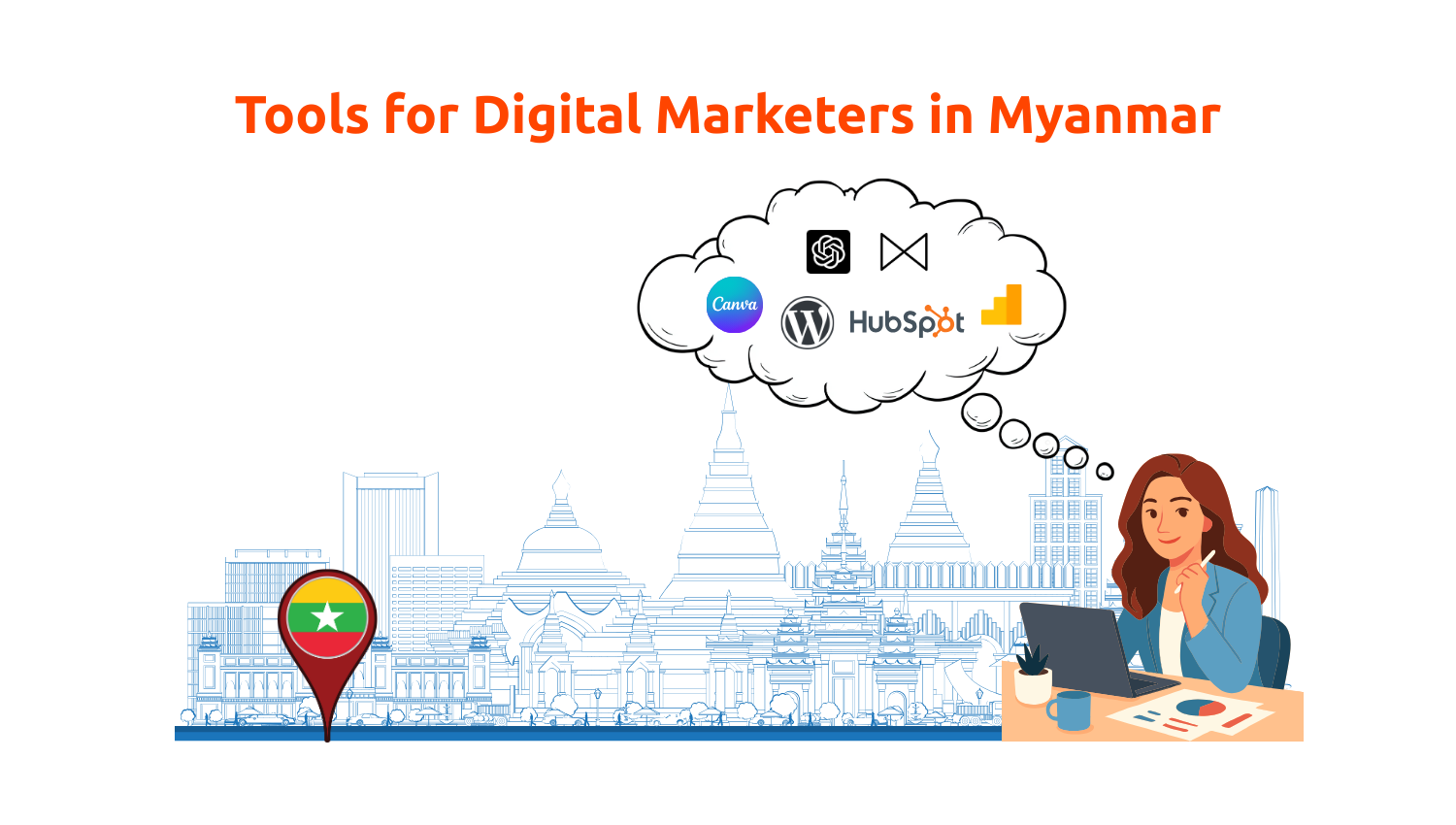
For a practical overview of the tools that Myanmar marketers are using to track and measure performance, check out the Tools for Digital Marketers in Myanmar guide , it covers both free and paid options that work within Myanmar's infrastructure realities.
Silent Killer #2: You Have No Funnel , You Are Asking for Marriage on the First Date
Here is the uncomfortable truth about most Myanmar business social media accounts: they are essentially one long sales pitch. Every post is either a product showcase, a price announcement, or a promotional offer. And while these posts have their place, they represent only one stage of the customer journey , the decision stage. You are asking people to buy before they even know who you are.
Think about how you make a purchase decision yourself. You do not see one post from a brand you have never heard of and immediately open your wallet. You discover them, you research them, you see them a few more times, you read some reviews, maybe you ask a friend, and then , once you trust them enough , you buy. That process is a funnel. And most Myanmar businesses have no funnel at all.
A proper digital funnel has three stages. The awareness stage is where people discover you , they see your TikTok video, your boosted Facebook post, or your article on Google. The consideration stage is where they evaluate you , they visit your website, read your about page, check your reviews, or follow you to see more of your content. The decision stage is where they convert , they message you, add to cart, fill in a form, or call you.
When your digital presence is only built for the decision stage, you are only reaching people who are already ready to buy. You are missing the much larger pool of people who could become customers if you warmed them up first. And because you are not nurturing them through the consideration stage, many potential customers fall off the path entirely , not because they did not want your product, but because you never gave them enough reason to trust you.
Building a proper marketing funnel does not have to be complicated or expensive. For a step-by-step breakdown of how Myanmar startups can build their first effective funnel before spending money on ads, I cover this in depth in the blog post Opportunities for Myanmar's Digital Marketers in 2026.
Silent Killer #3: You Have No Follow-Up System , Your Leads Are Dying in Your Inbox
This is the one that hurts the most when founders realise it, because it means money they already spent acquiring leads was partially wasted. Think about the last month of your business. How many people messaged you on Facebook or Instagram to ask about your product? How many of them actually bought?
Now think about the ones who did not buy. What happened to them? Did you follow up? Did you send them more information? Did you offer them a reason to come back? For the vast majority of Myanmar businesses, the answer is no. Someone messaged, you replied with a price, they said 'okay, I'll think about it,' and then they were never heard from again. That is not a sales problem , that is a system problem.
In the world of digital marketing, a lead that has expressed interest in your product but has not yet bought is one of the most valuable assets you have. They already know you exist. They are already considering you. With the right follow-up, a significant portion of those uncommitted leads will convert into paying customers. But only if you have a system to follow up with them.
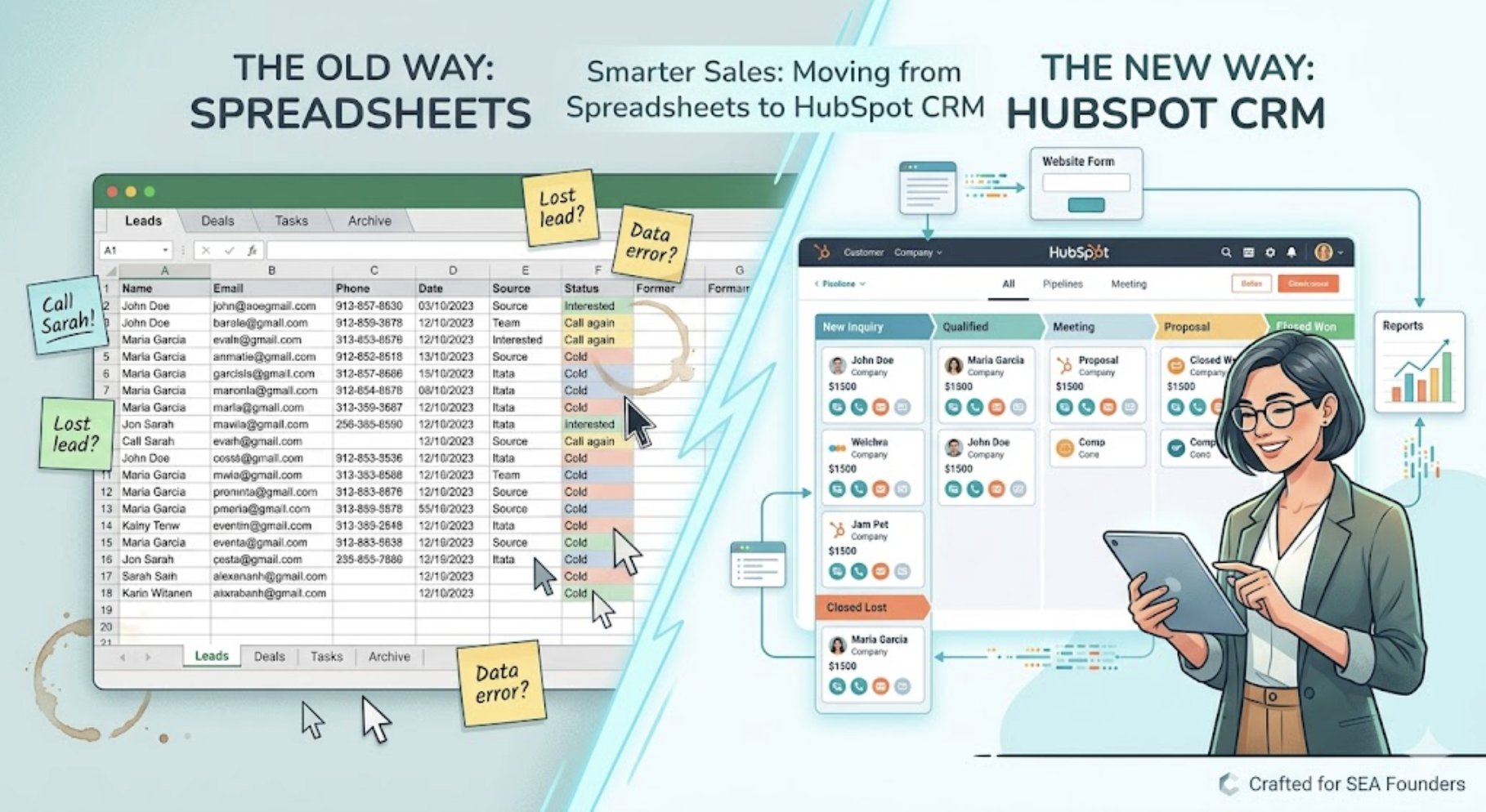
Most Myanmar founders manage their leads in their heads, in a notebook, or in a WhatsApp chat thread. When business is small, this works. When it grows , or when you want it to grow , it falls apart immediately. Leads get forgotten. Follow-ups happen inconsistently. No one can tell you how many active leads are in the pipeline right now, let alone their status.
A proper follow-up system does not have to be complex. At its most basic, it is a spreadsheet that tracks every lead, their status, and when you last contacted them. At a more sophisticated level, it is a CRM like HubSpot that automatically reminds you to follow up, sends pre-written emails on your behalf, and shows you exactly where every potential customer is in your sales process.
Part 3: What a Proper Digital Setup Actually Looks Like in 2026
Now that we have named the problems, let us talk about the solution. What does a properly functioning digital setup look like for a Myanmar startup in 2026? I want to be very clear that this does not need to be expensive or complicated. In fact, the best digital setups I have seen are remarkably simple , they just have all the right pieces connected together.
Layer 1: A Website That Actually Works For You
Your website is your digital headquarters. It is the one place online that you own completely , unlike your Facebook page, which Meta controls, or your TikTok account, which could be banned tomorrow. Every other platform should be driving people toward your website, because that is where they take the actions that matter: filling in a contact form, signing up for your email list, or making a purchase.
A website that works for your business is not just an online brochure. It is a conversion engine. It has a clear homepage that immediately answers three questions for every visitor: what do you do, who is it for, and why should I trust you? It has a contact form that feeds directly into your CRM. It has Google Analytics installed so you can see how many people visit, from where, and what they do. And it loads fast on a mobile phone, because that is how the overwhelming majority of your audience will see it.
For most Myanmar startups, I recommend building on HubSpot CMS. The reason is simple: it combines your website, your contact database, your email marketing, and your analytics all in one place. Instead of juggling five different tools that do not talk to each other, everything is connected. Every person who fills in a form on your website automatically appears in your contact database. Every email you send is tracked. Every page visit is recorded against a contact profile.
HubSpot is the gold standard for this kind of integrated setup, and it is more accessible for small businesses than most founders realise. According to HubSpot's official CMS documentation, the platform is designed specifically to allow growing businesses to have enterprise-level marketing infrastructure without enterprise-level complexity or cost.
Layer 2: A Content Strategy That Attracts and Nurtures
Content is how you attract strangers and turn them into warm leads before they ever contact you. And I want to reframe what 'content' means here, because for most founders it immediately conjures images of daily social media posts and video production , which feels exhausting and expensive.
Strategic content is different from busy content. Busy content is posting every day to fill your feed. Strategic content is creating the specific pieces of information that your ideal customer is searching for, and making sure they find it when they look. A single well-written blog post that answers a question your customers frequently ask can drive qualified traffic to your website for years. A TikTok video that honestly addresses a common misconception about your product category can go viral in ways that no amount of boosted posts can replicate.
The framework I use for Myanmar startups is simple. You need three types of content: attract content that brings new people in (SEO blog posts, TikTok videos, shareable social posts), nurture content that builds trust with people already aware of you (in-depth guides, case studies, behind-the-scenes content), and convert content that pushes warm leads to take action (testimonials, service pages, free consultations, limited offers).
Most Myanmar businesses only produce attract and convert content. They create awareness posts and sales posts. But they skip the nurture layer entirely , which is the layer that actually turns interested people into confident buyers. Filling that gap is often the single fastest way to improve conversion rates without spending more on advertising.
Layer 3: A CRM That Tracks Every Lead
A CRM , Customer Relationship Management system , is simply a database of every person who has ever interacted with your business, combined with a record of every interaction you have had with them. It sounds corporate and complicated. In practice, for a small business, it is one of the most powerful and practical tools you can have.
With a CRM, you always know the answer to these questions: how many leads do I have right now? Who have I not followed up with in the last week? Who is most likely to buy this month? Which of my customers has bought more than three times and might be ready for an upsell? Without a CRM, you are answering these questions from memory, which means you are almost certainly getting them wrong.
For startups just getting started with a CRM, HubSpot offers a genuinely free version that is powerful enough for most small businesses. You can track contacts, log notes from conversations, set follow-up reminders, and see a visual pipeline of where every deal stands. As your business grows, it scales with you , adding email automation, reporting dashboards, and deeper integrations without requiring you to migrate to a new system.
Layer 4: Automated Email Follow-Up
Once you have a website that captures leads and a CRM that stores them, the next piece of the puzzle is automated follow-up. This is where a huge amount of revenue is hiding for most Myanmar businesses.
Imagine this: someone fills in your contact form at 11pm on a Sunday. Instead of waiting until Monday when you are back at your desk, they immediately receive a warm, personalised email thanking them for reaching out, telling them what to expect next, and giving them a piece of valuable content that addresses their most common question. By the time you call them on Monday morning, they already feel like they know your brand. They are warm. The sale is much easier to close.
This kind of automated email sequence is not just for large companies. It takes a few hours to set up in HubSpot and then runs completely on autopilot, sending the right message to the right person at the right time , every single time, without you having to remember to do it.
According to research from Campaign Monitor, automated email sequences have an average open rate of 35-40%, compared to 15-20% for regular broadcast emails. That is because they are timely and relevant , they arrive at the exact moment when a lead is most interested.
Layer 5: Analytics and Reporting That Drive Decisions
The final layer of a proper digital setup is visibility , the ability to look at your marketing performance and make informed decisions based on what you see. This means having dashboards that show you, at a glance, how many people visited your website this week, how many became leads, how many of those leads became customers, and how much each customer cost you to acquire.
When you have this visibility, every marketing decision improves. You stop guessing and start optimising. You can see that your TikTok content is driving three times more qualified leads than your Facebook posts and shift your energy accordingly. You can see that leads who read your blog before contacting you close at twice the rate of leads who come directly from ads, so you invest more in content. You can see that your email open rate dropped last month and investigate why.
This is what separates businesses that grow predictably from businesses that grow sporadically. Not budget. Not luck. Not even product quality. Systems and visibility.
Part 4: Real Signals That Your Digital Setup Is Broken
Let me give you a practical checklist. These are the warning signs I look for when I work with a new startup client. If you recognise more than three of these in your own business, you have a digital system problem , not a marketing budget problem.
- You cannot tell me, off the top of your head, how many new leads you received last month and where they came from.
- Your contact list is a mixture of WhatsApp groups, a notebook, a Facebook Messenger inbox, and a spreadsheet that someone started once and never finished.
- You have boosted Facebook posts that got thousands of views but you have no idea whether any of those views resulted in a sale.
- When someone fills in your contact form or DMs you, the follow-up depends entirely on whether you or your team remember to do it.
- Your website (if you have one) is essentially a digital brochure , it has your products, your contact information, and maybe an about page, but it does not capture any leads or give you any data about who visited.
- You regularly hear from customers that they tried to contact you but 'fell through the cracks.'
- When a staff member leaves, some customer relationships effectively leave with them because the contact history lives in their personal phone.
- You spend time every week manually sending the same follow-up messages that you have sent a hundred times before.
These are not signs of a failing business. They are signs of a growing business that has outgrown its informal systems. The good news is that fixing them does not require a massive budget or a full-time tech team. It requires the right setup.
Part 5: Back to Zaw , What Happened When He Fixed His System
Let us go back to Zaw Win and his skincare brand. After we identified his three silent killers , no tracking, no funnel, no follow-up system , we did not immediately start spending more on ads. We fixed the foundation first.
First, we set up proper tracking. Google Analytics on his website. Facebook Pixel on his page. UTM parameters on every link in every post. Within two weeks, we had data we had never had before. And what it showed was surprising: the majority of his actual paying customers were coming from organic Google searches , people looking for 'natural skincare Myanmar' or 'Shan ingredient face cream' , not from his boosted Facebook posts at all. He had been spending most of his ad budget on the wrong channel.
Second, we built a simple three-stage funnel. We created a free 'Skincare Guide for Myanmar's Climate' PDF that people could download from his website in exchange for their email address. This gave us a way to capture leads who were interested but not yet ready to buy. Then we set up a five-email welcome sequence in HubSpot that introduced the brand, shared customer stories, explained the ingredients, and eventually made a personalized offer. This nurture sequence ran automatically every time someone downloaded the guide.
Third, we moved his entire contact management into HubSpot. Every lead from the website form, every existing customer, every inquiry from Facebook , all of it went into one database. We set up a simple pipeline with five stages: New Lead, Contacted, Interested, Proposal Sent, and Customer. Every morning, Zaw could open HubSpot and see exactly where every active opportunity stood.
The results over the following 90 days were not magic , they were the predictable outcome of fixing a broken system. His customer base grew from 250 to 390 active monthly buyers. His ad spend actually decreased because he stopped boosting Facebook posts that were not converting and focused his budget on the Google search channel that was actually driving buyers. His follow-up rate went from sporadic to 100% , because HubSpot did it automatically.
Zaw did not need more followers. He did not need a bigger budget. He needed a system that could catch the leads he was already generating and convert them into customers.
Part 6: The Myanmar Founder's Digital Checklist for 2026
Here is a practical checklist you can use to assess your own digital setup right now. Go through each item honestly. This is not about judging where you are , it is about understanding what to prioritise next.
Foundation (Must Have)
- Google Analytics 4 installed on your website and actively monitored
- Facebook Pixel connected and firing correctly on all key pages
- A contact form on your website that captures name, email, and message
- A CRM (even a simple spreadsheet to start) where every lead is recorded
Growth (Should Have)
- A lead magnet (free resource) that gives people a reason to share their email
- An automated welcome email sequence for new leads
- A content calendar with at least one piece of nurture content per week
- A structured sales pipeline in your CRM with defined stages
Optimisation (Nice to Have)
- Monthly reporting dashboard showing leads, conversions, and cost per acquisition
- A/B testing on your top-performing ad creatives
- Customer segmentation in your CRM for personalised messaging
- Integration between your website, CRM, and email marketing platform
For the AI-powered tools that can help you implement and optimise all of the above, the Role of AI in Digital Marketing in Myanmar post covers 10 specific AI prompts that will save you hours of work every week.
Part 7: Why Most Founders Do Not Fix This (And Why You Should)
I have had this conversation with dozens of founders across Myanmar and Thailand. I show them the data, I walk them through the checklist, I explain exactly what is broken and why. And the response is almost always the same: 'I know I need to fix this. I just have not had time.'
I understand that response completely. You are running a business. You are managing suppliers, staff, customers, finances, and about forty other things simultaneously. Setting up a CRM and building an email automation sequence does not feel as urgent as responding to the customer who is messaging you right now.
But here is what I want you to sit with: every month you delay fixing your digital foundation, you are not just losing potential customers , you are spending money and energy on marketing that is far less effective than it could be. You are paying to attract people to a leaking bucket. The water goes in, but it also goes out.
The cost of not having a system is invisible, which is why it is so easy to ignore. You do not receive an invoice for the leads that fell through the cracks. You do not see a line item for the ad spend that went to the wrong channel. You do not get a report showing the customers who almost bought but did not because no one followed up. These costs are real , they are just hidden.
And unlike hiring another salesperson or spending more on ads, fixing your digital foundation is a one-time investment that pays dividends permanently. You set up HubSpot once, and it tracks every lead forever. You write your welcome email sequence once, and it sends to every new lead automatically. You install Google Analytics once, and it collects data every single day without you doing anything.
According to a Salesforce study on CRM adoption, businesses that implement a CRM see an average 29% increase in sales revenue, a 34% increase in sales productivity, and a 42% improvement in forecast accuracy. These are not marginal gains , they are transformative. And they come not from spending more money on marketing, but from getting more out of the marketing you are already doing.
Part 8: The Difference Between a Digital Presence and a Digital System
I want to end with a distinction that I think is the most important idea in this entire post, because it reframes everything.
A digital presence is what most Myanmar businesses have. It is a Facebook page, maybe an Instagram account, perhaps a basic website. It is visible. It exists. It might even look impressive. But it is passive. It waits for customers to come to it. It does not track them. It does not follow up. It does not learn or improve over time. It is a billboard on a road , it can be seen, but it does not do anything with the people who see it.
A digital system is what successful businesses have. It is an interconnected set of tools and processes that actively works to turn strangers into leads, leads into customers, and customers into repeat buyers and advocates. It tracks everything, automates the repetitive parts, and gives you the visibility to make better decisions every month. It does not sleep. It does not forget to follow up. It does not lose contacts.
The gap between these two things is the gap between a business that grows whenever the founder works harder and a business that grows even when the founder takes a weekend off.
Zaw Win now has a digital system. He checks his HubSpot dashboard every morning. He knows exactly how many leads came in this week and where they came from. His welcome email sequence is warming up new leads around the clock. His follow-up reminders mean no lead goes cold for more than three days. He is not working harder than before , he is working with better information and better tools.
That is what building a proper digital system does. It does not replace your effort , it multiplies it.
Conclusion: Your Next Step
If you have read this far, you already know which of the three silent killers is hurting your business most. Maybe it is the tracking gap , you have no idea where your customers are actually coming from. Maybe it is the funnel gap , you are only talking to people who are already ready to buy. Maybe it is the follow-up gap , your leads are dying in your inbox because no one is catching them.
Whatever it is, the fix starts with an honest assessment of where you are and a clear plan for what to build next. That does not have to be a massive overhaul. It can start with a single step , installing Google Analytics this week, setting up a free HubSpot account this weekend, or writing your first automated welcome email next Monday.
Small, compounding improvements to your digital system add up faster than you think. And each fix you make stops a leak in your bucket , meaning every lead you were already generating starts converting at a higher rate, without you spending a single extra kyat on advertising.
If you would like help auditing your current digital setup and building a clear, practical plan for what to fix first, I work directly with founders and small marketing teams across Myanmar and Southeast Asia to do exactly that. No jargon. No complicated proposals. Just a clear picture of where you are, where you want to go, and the most direct path between the two.
Ready to find out exactly where your digital funnel is leaking? Let's talk.
→ Book a free 30-minute digital audit with Min Thu Khant