I Built a HubSpot Website for a Bangkok Condo Business Targeting Myanmar Buyers ,Here's What Changed in 90 Days
 By
By
Reading time: ~20 minutes
The Facebook Page That Was Almost Enough
Ko Aung manages a small real estate business in Bangkok. His niche is unusually specific and genuinely underserved: he helps Myanmar nationals , expats, business owners, and families relocating from Yangon or Mandalay , find, rent, and purchase condominiums in Bangkok. He knows the pain points intimately because he lived them himself when he first moved to Thailand. He speaks the language, understands the paperwork, and knows which developers are Myanmar-buyer-friendly and which are not.
For the first two years of his business, Ko Aung ran everything through a Facebook Page and a Line account. And honestly? It worked reasonably well. The Myanmar community in Bangkok is tight-knit and active on Facebook. Referrals came in through shared posts. People messaged him directly. He handled inquiries personally, gave advice generously, and built a solid reputation one conversation at a time.
But by the time he came to me, he had hit a ceiling that Facebook and Line could not break through. His page had over 3,000 followers. He was posting regularly , new listings, neighbourhood guides, tips for Myanmar nationals buying property in Thailand. Engagement was decent. But his actual lead flow was unpredictable. Some weeks he would get five serious inquiries. Other weeks, nothing. He had no way of knowing why, no way of capturing people who looked at his posts but did not message, and absolutely no system for following up with people who had expressed interest months ago and then gone quiet.
More critically: when a serious buyer reached out, Ko Aung had no professional home to send them to. No website. No property listings page. No contact form. No credibility signals beyond a Facebook page , which, for a buyer about to make a decision involving hundreds of thousands of Thai baht, is simply not enough. Several buyers told him directly that they had considered working with him but went with another agent because they could not find enough information about him online to feel confident.
That last piece of feedback is what prompted the conversation. Ko Aung was not losing clients because of his service. He was losing them before they ever became clients, because his digital presence could not support the level of trust that a property purchase requires.
What followed was a 90-day HubSpot CMS website build and integration project specifically designed for his Myanmar-buyer real estate business. This post is an honest account of what we built, why we made each decision, and what changed as a result.
Part 1: Why a Myanmar Real Estate Business Specifically Needs HubSpot , Not Just a Website
Before I explain what we built, I want to address a question Ko Aung asked me early in our first meeting: 'Can I not just build a WordPress site and add listings? Why does it need to be HubSpot?'
It is a fair question. A WordPress site with a listings plugin would have been cheaper upfront and faster to launch. For some businesses, that is the right call. But for Ko Aung's specific situation , a one-person operation targeting a niche, high-trust, high-value buyer segment across two countries and two languages , a static website was not the answer. What he needed was a system that could attract Myanmar buyers searching online, capture their details even if they were not ready to inquire immediately, nurture them over the weeks or months it takes to make a property decision, and give him full visibility into who was engaging with his content and when.
A WordPress site does the first thing. HubSpot CMS does all four. And in real estate , where the average buyer takes between three and six months from initial research to signing a contract , the nurture phase is not optional. It is where the deal is won or lost.
The Myanmar buyer journey is longer and more trust-dependent than average
Myanmar nationals buying or renting in Bangkok face a unique set of challenges that make the trust-building phase especially important. Many are navigating Thai property law for the first time. Some are managing the transaction remotely, from Yangon or Mandalay, before relocating. Many have concerns about whether foreign nationals can legally own condominiums in Thailand (they can, with conditions). They need an agent who not only knows the market but can explain the process in a way that feels safe and culturally familiar.
This means a Myanmar buyer rarely messages an agent after seeing a single post. They research. They read. They look for evidence that this person knows what they are talking about. They look for a professional website, informative content, clear contact information, and ideally testimonials from other Myanmar buyers. A Facebook page, however well-managed, cannot deliver all of these signals. A HubSpot-powered website can.
For context on how Myanmar consumers research and make decisions digitally, the History and Evolution of Myanmar Digital Marketing post explains the trust dynamics that shape how Myanmar buyers engage with businesses online , including why a professional web presence matters more for this audience than many marketers assume.
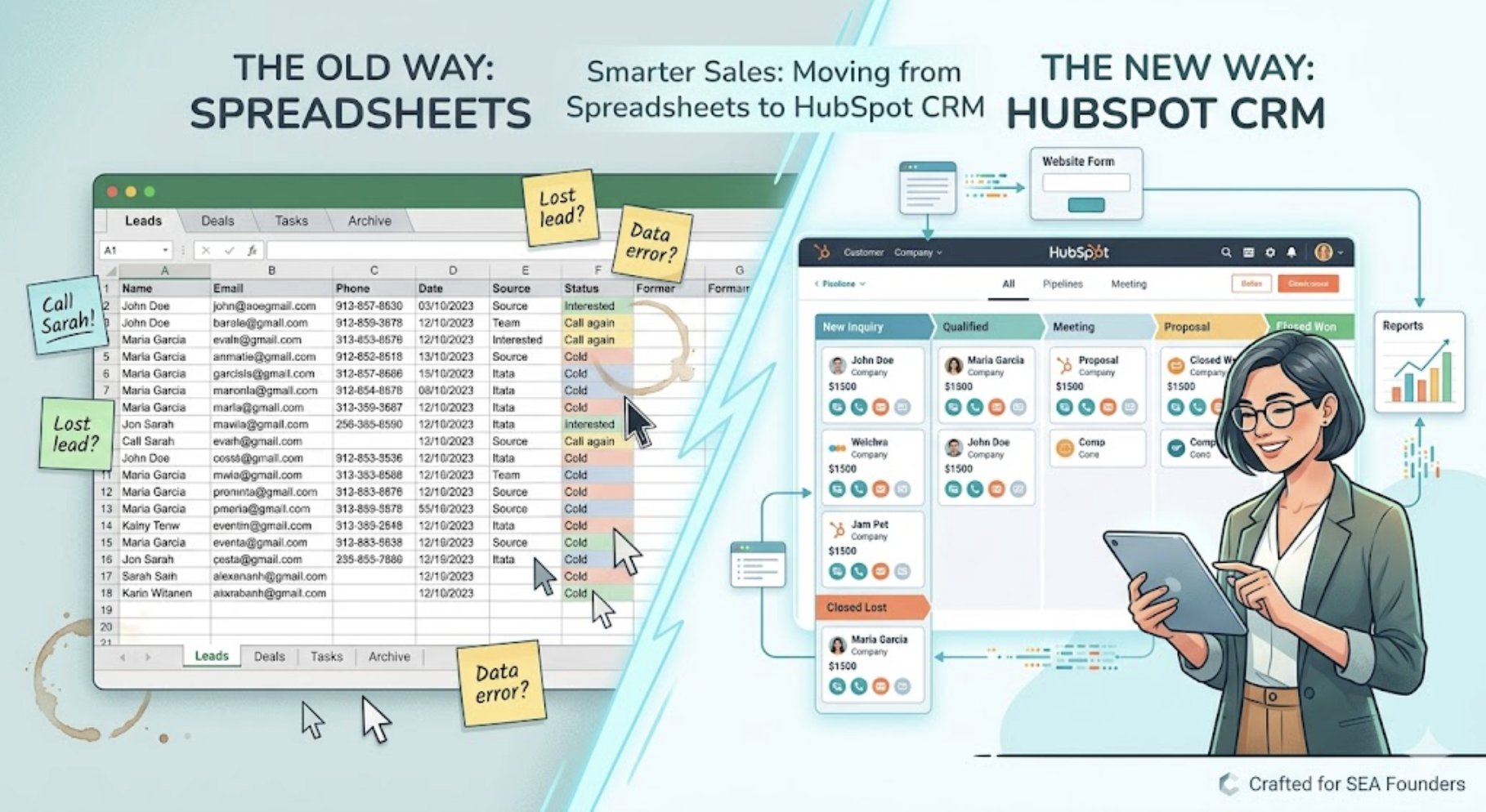
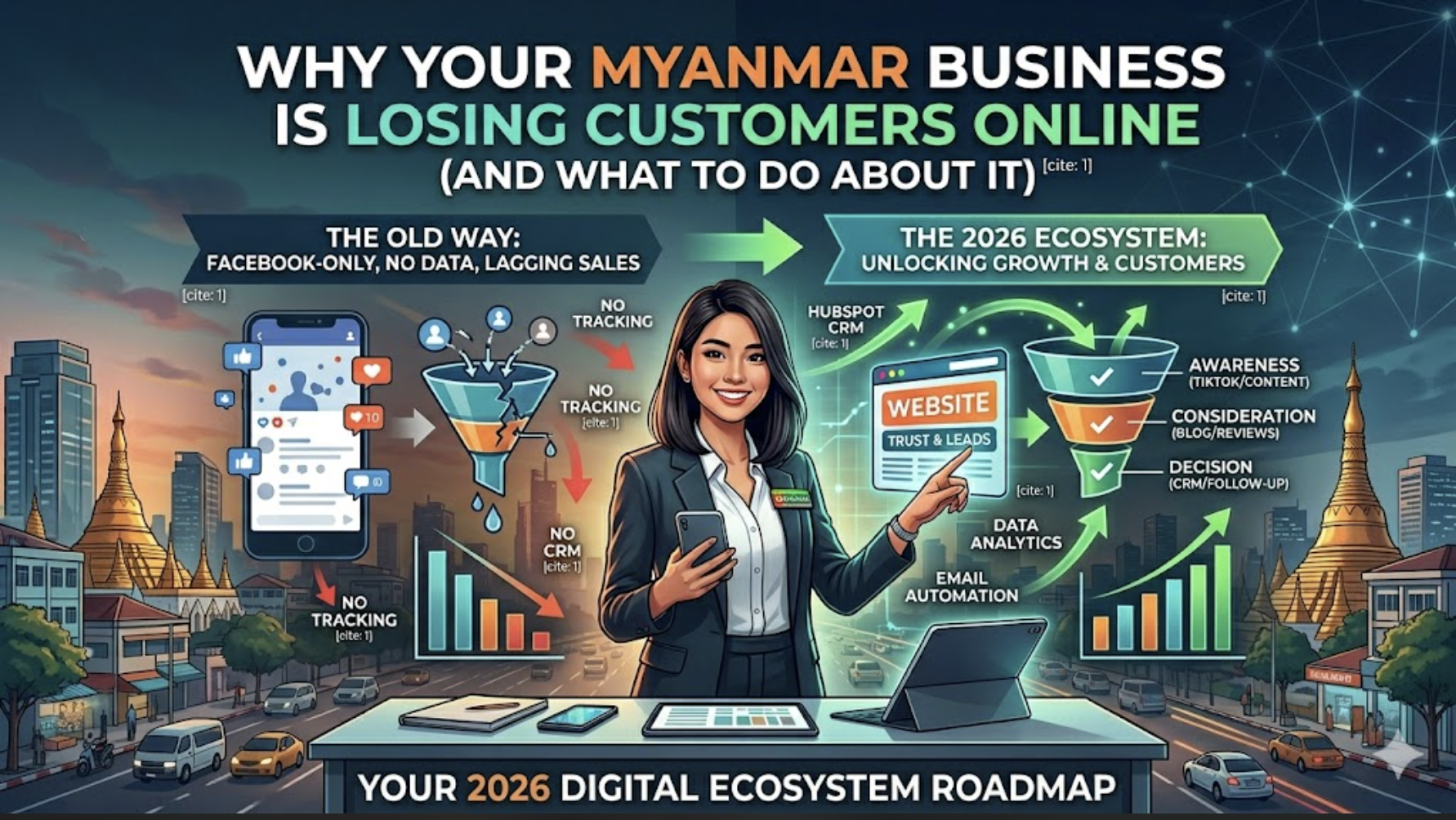
Part 2: The Before Picture , Facebook and Line, Nothing Else
Let me be specific about what Ko Aung's digital setup looked like before the project began, because I want you to see how common this starting point is , and how much room there is to grow from it.
Facebook Page
3,200 followers. Regular posts , approximately four to five per week , featuring new listings, neighbourhood content, and occasional tips for Myanmar buyers. Engagement was moderate: likes and reactions were common, comments were occasional, and direct messages came in irregularly. Ko Aung responded to every message personally, often within the hour, because everything ran through his personal phone. There was no way to know how many people had seen a post and not messaged. There was no pixel installed. There was no retargeting. There was no record of past inquiries beyond the Messenger thread itself.
Line Official Account
Ko Aung had a Line Official Account with around 180 contacts. He used it primarily for one-to-one communication with active leads , sending listings, answering questions, arranging viewings. Line was where deals actually progressed. But because Line is a messaging tool rather than a marketing platform, there was no segmentation, no broadcast scheduling, no automation, and no data. He could not tell you which of his 180 Line contacts were active buyers, which were past clients, and which had added him once and never engaged again.
No website, no email list, no CRM
Zero. No website. No email marketing. No contact database beyond Facebook Messenger history and Line chat threads. No way to be found on Google. No professional home to send buyers to when they wanted to research further. If someone searched 'Myanmar real estate agent Bangkok' or 'condo for rent Bangkok Myanmar' on Google, Ko Aung's business was completely invisible.
This is a genuinely common situation for service businesses in the Myanmar community in Bangkok. Facebook and Line work well enough in the early stages of a business to delay the investment in a proper digital infrastructure. But they have hard limits , and Ko Aung had reached them.
Part 3: What We Built , The 90-Day HubSpot CMS Project
The project ran in three phases over 90 days. Each phase had a clear deliverable, and we were deliberate about sequencing , building the foundation before the automation, and the automation before the optimisation.
Phase 1 (Days 1–30): Building the HubSpot website
The first month was focused entirely on the website. We chose HubSpot CMS as the platform for several reasons: it integrates natively with HubSpot's CRM, meaning every visitor, every form submission, and every contact becomes instantly trackable without any third-party plugin. It loads fast on mobile , critical for a Myanmar audience that accesses almost everything on their phones. And it comes with built-in SEO tools, analytics, and a forms system that feeds directly into the contact database.
We designed the site in both English and Burmese. This was a deliberate and important decision. Myanmar buyers researching property in Bangkok are comfortable with English, but when someone is making a major financial decision, reading information in their native language builds a qualitatively different level of trust. The bilingual approach immediately differentiated Ko Aung from every other Bangkok real estate agent competing for this audience.
The site structure was built around the buyer journey, not around Ko Aung's services. Instead of a homepage that said 'here is what I offer,' it led with 'here is what you are trying to do, and here is how I can help you do it.' The main pages were: Home (who this is for and why Ko Aung), Rent in Bangkok (tailored for Myanmar expats looking for rental condos), Buy in Bangkok (tailored for Myanmar nationals purchasing property), Neighbourhoods (guides to Sukhumvit, Silom, Sathorn, and other Bangkok areas popular with Myanmar buyers), FAQ (addressing the most common Myanmar buyer questions about Thai property law), and Contact.
Every page had a HubSpot form , not just the contact page. A listing inquiry form. A neighbourhood guide download form. A free consultation booking form using HubSpot's meeting scheduler. Each form fed directly into the CRM, creating a contact record with the source, the page, and the specific interest area automatically tagged.
The HubSpot tracking code was installed from day one, meaning we were collecting data on every single visitor from the moment the site went live , which pages they viewed, how long they stayed, whether they returned, and if they were a known contact, all of this was attached to their profile automatically.
Phase 2 (Days 31–60): Lead magnets and email automation
With the website live and collecting data, phase two focused on building the lead capture and nurture system. We created two lead magnets specifically designed for Ko Aung's Myanmar buyer audience.
The first was a PDF guide titled 'The Myanmar Buyer's Complete Guide to Renting a Condo in Bangkok.' Written in both English and Burmese, it covered the practical steps of renting as a foreign national , what documents you need, how deposits work, what to look for in a lease agreement, and which neighbourhoods suit different lifestyles and budgets. Ko Aung could write this in his sleep because it was exactly what he explained to every new client anyway. We simply structured it, formatted it, and made it downloadable in exchange for an email address.
The second was a property alert sign-up , a simple form where buyers could specify their requirements (budget, area, bedrooms, rent or buy) and receive email alerts when Ko Aung listed matching properties. This was not a complex automated listing system , it was a manual process on Ko Aung's end, sending personalised emails when he had a relevant property. But the sign-up form captured a committed lead with specific, declared intent, which is enormously valuable.
We then built three automated email sequences in HubSpot. The welcome sequence went to anyone who downloaded the rental guide: five emails over 14 days, each delivering a piece of genuine value , a neighbourhood comparison, a guide to the BTS Skytrain lines most convenient for Myanmar expat communities, a breakdown of typical rental costs by area, a Q&A on Thai lease agreements, and finally a gentle invitation to book a free consultation. The property alert sequence went to sign-ups and delivered new listings with a personalised intro referencing the buyer's stated preferences. The re-engagement sequence went to contacts who had been inactive for 60 days , a simple, personal-feeling email from Ko Aung asking if their plans had changed and offering a fresh conversation.
Phase 3 (Days 61–90): CRM pipeline, SEO, and optimisation
The final phase focused on making the system intelligent. We set up a deal pipeline in HubSpot with stages that matched the real estate sales process: New Inquiry, Consultation Booked, Viewing Arranged, Offer Stage, Contract Signed, and Closed. Every active buyer was entered into the pipeline with their budget, preferred area, and timeline noted as custom properties.
We also did a focused round of SEO work on the website. We identified the specific search terms Myanmar buyers in Bangkok use when looking for property help , terms like 'Myanmar agent Bangkok condo,' 'rent Bangkok Myanmar expat,' and 'buy condo Bangkok foreign national guide.' We optimised the page titles, meta descriptions, headings, and content on each key page for these terms. This was not aggressive SEO , the site was new and would take time to build authority , but planting the right seeds in week eight means the harvest comes earlier.
We also connected Ko Aung's existing Facebook Page to HubSpot using a basic integration, so that any leads generated through Facebook Lead Ads automatically entered the CRM and triggered the appropriate email sequence. This bridged his existing Facebook presence with the new system rather than abandoning it.
Part 4: What Changed in 90 Days , The Honest Results
I want to give you an honest picture here, not a glossy case study. Some things changed dramatically. Some things took longer than expected. And one or two things did not work the way we anticipated at all.
What changed immediately
- Ko Aung had a professional home to send buyers to. For the first time, when a potential client asked 'do you have a website?' the answer was yes , with bilingual content, a professional design, and clear information about his services tailored exactly to Myanmar buyers. The feedback from early visitors was immediate and consistent: it felt credible and trustworthy in a way that a Facebook page alone never had.
- Every inquiry was now captured and tracked. Whether a buyer came from Facebook, found the site on Google, or was referred by a friend, their details went into HubSpot automatically. Ko Aung could see, for the first time, the complete list of people who had expressed interest , not scattered across Messenger threads and Line chats, but in a single organised database.
- The meeting scheduler reduced friction immediately. Buyers could book a free consultation directly from the website without any back-and-forth messaging. In the first 30 days, 14 consultations were booked this way , all self-qualified leads who had already read the site content and understood Ko Aung's niche.
What changed by Day 60
- The rental guide was downloaded 78 times in the first 60 days. Every download became a contact in HubSpot, entering the welcome email sequence automatically. The sequence achieved an average open rate of 44% across the five emails , well above the industry benchmark for automated real estate email sequences, which according to HubSpot's own data averages around 26-28% for the property sector.
- The property alert sign-up captured 31 subscribers with declared purchase or rental intent. These were not casual followers , they had specified a budget, a preferred area, and a timeline. Ko Aung described these as the highest-quality leads he had ever received, because the intent was explicit rather than inferred.
- Google Search Console showed the website beginning to appear in search results for several target keywords within the first 60 days. Not on page one yet , that takes longer , but indexed, crawled, and building authority. Three organic website visitors came through Google search by day 60, which sounds modest but is three more than zero, and the trajectory was upward.
What changed by Day 90
- Four rental contracts and one condo purchase were directly attributed to leads that came through the HubSpot website system during the 90-day period. Two came from the rental guide download sequence, two from the meeting scheduler, and one from the property alert sign-up. Combined, these five transactions covered the cost of the website build and HubSpot subscription for the full first year, with significant revenue remaining.
- Ko Aung's contact database grew from essentially zero structured contacts to 147 tagged, segmented entries in HubSpot , each with a source, an interest area, an engagement history, and a pipeline stage. For the first time, he could tell you exactly how many active buyers he was working with, how many were in early research, and which ones had gone quiet and needed a nudge.
- His Facebook Page, rather than becoming less important, became more effective , because it now had somewhere meaningful to send traffic. Posts that had previously generated likes and comments now generated website visits, guide downloads, and consultation bookings. The Facebook presence and the HubSpot system reinforced each other rather than operating in isolation.
What did not go as planned
The bilingual Burmese content took significantly longer to produce than expected. Ko Aung is fluent in Burmese but not comfortable writing formal marketing copy in the language, and finding a reliable translator for real estate specific terminology added two weeks to the timeline. If you are planning a bilingual HubSpot site for a Myanmar audience, budget for this , the content is worth it, but it takes longer than you think.
SEO results within 90 days were modest, as expected for a brand new domain. This is not a failure , it is the nature of organic search. The foundation was built correctly, and the returns will compound over the following 6 to 12 months. But any founder expecting Google traffic to flow in the first three months will be disappointed. Paid search (Google Ads targeting Myanmar buyer keywords) is the right short-term complement to long-term SEO for this niche, and we are exploring that in month four.
Part 5: The Five Design Decisions That Made the Biggest Difference
Looking back on the 90 days, five specific decisions stand out as having the most impact on the results. These are not HubSpot-specific insights , they are strategic choices that any real estate business targeting a niche international audience should consider.
1. Bilingual content from day one
The decision to launch with both English and Burmese content was the single most differentiating factor in the entire project. No other Bangkok real estate agent operating in this niche had a professional bilingual website. The signal it sends to a Myanmar buyer is not just practical convenience , it is cultural respect. It says: I built this for you specifically, not for a general market that happens to include you. That signal matters enormously in high-trust, high-value transactions like property purchases.
2. Buyer-journey page structure over service-led structure
Organising the site around what buyers are trying to do , rent, buy, understand the neighbourhoods, understand the legal process , rather than around Ko Aung's services meant that visitors immediately found information relevant to their specific stage. A buyer who is still in the research phase lands on the Neighbourhoods or FAQ page and finds exactly what they need. A buyer who is ready to act lands on the Rent or Buy page and finds a clear path to a consultation. Meeting people where they are, rather than where you want them to be, is the fundamental principle of a buyer-journey website structure.
3. The lead magnet as a trust signal, not just a list-builder
The rental guide was designed to be genuinely useful , the kind of document that someone would share with a friend who was also considering moving to Bangkok. This matters because a lead magnet that delivers real value does two things simultaneously: it builds the email list, and it builds trust. A buyer who reads the guide and finds it helpful already knows that Ko Aung is knowledgeable, generous with information, and understands their specific situation. By the time they book a consultation, the relationship is already warm.
4. Connecting Facebook to HubSpot rather than replacing it
A common mistake when building a new digital system is to treat it as a replacement for what existed before, rather than an enhancement of it. Ko Aung's Facebook Page was an asset , 3,200 followers who had self-selected into his content. Rather than abandoning it or reducing investment in it, we connected it to HubSpot so that Facebook-generated leads automatically entered the CRM system. This meant his existing audience became part of the new system rather than being left behind.
5. Declaring intent through the property alert sign-up
The property alert sign-up was a simple but powerful lead qualification tool. By asking buyers to specify their budget, preferred area, and rental or purchase intent at the point of sign-up, we created a segment of contacts with declared, specific interest rather than general curiosity. These contacts , even though they numbered only 31 in the first 90 days , were qualitatively more valuable than passive followers, because they had taken an active step that signalled genuine buying intent. One of the five transactions closed in the 90-day period came directly from this segment.
Part 6: What a HubSpot CMS Build Actually Involves for a Real Estate Business
I want to demystify what it actually looks like to build a HubSpot CMS website for a business like Ko Aung's, because the process is often imagined as far more complicated than it is in practice.
What you need to start
- A HubSpot account , the CMS Starter plan is sufficient for a basic website with forms, a blog, and CRM integration. For marketing automation and email sequences, HubSpot's Marketing Hub Starter adds these features at an accessible price point.
- Your content , the copy for each page, your listings information, and ideally a lead magnet concept. The platform is easy to build on; the content is where most of the real work lives.
- A domain name , if you do not have one, registering a domain takes ten minutes and costs around 500 baht per year.
- A clear picture of your buyer , specifically, what questions they are asking, what concerns they have, and what information would help them trust you enough to take the next step.
What the typical timeline looks like
- Week 1–2: Strategy, structure, and content planning. Defining the page structure, lead magnet concept, and email sequence outline.
- Week 3–4: Website build. Designing and building the core pages in HubSpot CMS, integrating forms, and installing tracking.
- Week 5–6: Content production. Writing page copy, producing the lead magnet, and drafting email sequences.
- Week 7–8: Launch and automation setup. Going live, activating email sequences, and connecting existing social channels.
- Week 9–12: Optimisation. Reviewing early data, adjusting page content, refining sequences based on open and click rates.
For a broader look at the tools and platforms that work best within the Myanmar and Thailand digital ecosystem, the Tools for Digital Marketers in Myanmar post covers the stack that works best for small teams operating across both markets.
Part 7: The Broader Lesson , Why Niche Businesses Need Niche Digital Systems
Ko Aung's business is a useful case study not just for real estate agents, but for any founder running a niche, community-specific service business in Southeast Asia. The dynamics are the same whether you are a Myanmar accountant serving expats in Bangkok, a Thai architect specialising in projects for foreign investors, or a bilingual education consultant helping Myanmar families navigate international school admissions.
Niche businesses have a structural advantage in digital marketing: their audience is specific enough that highly targeted content performs far better than broad content. A guide specifically for Myanmar nationals buying property in Bangkok will outperform a generic Bangkok property guide in search, in engagement, and in trust-building , even if it reaches a smaller total audience , because it speaks directly and completely to the person reading it.
But this advantage only activates if the digital infrastructure can capture and nurture the niche audience effectively. A Facebook page alone cannot do this. It can attract attention, but it cannot systematically capture leads, track behaviour, warm up buyers over months, or give you the pipeline visibility to run your business with confidence. That is what a properly integrated HubSpot CMS website delivers.
If you want to understand how AI tools can help you produce the bilingual, niche-specific content that makes this kind of system work, the Role of AI in Digital Marketing in Myanmar post includes specific prompts for generating localised, culturally relevant content quickly , including prompts for creating lead magnets and email sequences for Myanmar-specific audiences.
Part 8: The ROI Calculation for a HubSpot Real Estate Website
Let me give you a straightforward way to think about the return on investment for a project like this, using Ko Aung's business as the example.
In Bangkok real estate, an agent's commission on a rental transaction is typically one month's rent. For a mid-range condo in areas like Sukhumvit or Silom , popular with Myanmar expats , that is approximately 25,000 to 45,000 Thai baht per transaction. A purchase transaction generates significantly more. Ko Aung's five transactions in 90 days, at conservative commission estimates, generated a return that covered the full cost of the HubSpot setup and the first year of the subscription within the first quarter.
But the more important number is not the 90-day return. It is the compounding value of the system over time. The 147 contacts in Ko Aung's HubSpot database are not a one-time asset , they are an ongoing relationship pipeline. Some of those contacts will transact in month four. Some in month eight. Some will refer a friend. Some will come back when their lease ends in two years. Every one of those future transactions flows through the system that was built in the first 90 days, at no additional setup cost.
According to research from the National Association of Realtors, 41% of buyers find their real estate agent through a referral, and agents who maintain consistent digital communication with past clients and leads generate referral rates 2.5 times higher than those who do not. A HubSpot system that keeps Ko Aung in contact with his growing database , through listing alerts, neighbourhood updates, and occasional personal check-ins , is not just a lead-generation tool. It is a referral engine.
For a broader framework on how digital marketing investment compounds over time for SEA businesses, the Opportunities for Myanmar's Digital Marketers in 2026 post outlines the long-term investment logic behind building proper digital infrastructure in the current market.
Conclusion: What Day 91 Looks Like
On Day 91, Ko Aung's morning routine looked like this. He opened HubSpot on his phone over coffee. His dashboard showed three new website visitors overnight, one new rental guide download from a contact in Mandalay who was planning a Bangkok move in two months, and one consultation booked through the meeting scheduler for Thursday afternoon. He checked his pipeline , seven active buyers at various stages, two in the Offer Stage , and sent a quick personal follow-up message via Line to the two buyers he had not heard from in five days, triggered by a HubSpot reminder he had set the week before.
The whole thing took eleven minutes.
Compare that to Day 1, when his morning started with a scroll through several hundred Messenger threads and Line chats, trying to piece together from memory who he had spoken to, who was serious, and who had gone quiet. The same information that now appeared automatically in a clean dashboard had previously lived in his head, degrading with every passing day.
This is what a properly built HubSpot CMS system does for a niche service business. It does not replace the relationships , Ko Aung still builds those through his genuine knowledge, his cultural fluency, and his personal care for his clients. But it gives those relationships a system to live in, grow in, and generate value from consistently , even on the mornings when Ko Aung is showing properties all day and has no time to manually manage his pipeline.
If you are running a niche service business in Myanmar or Southeast Asia , whether in real estate, consulting, education, health, or any other field , and your digital presence currently lives entirely on Facebook and Line, this story is your starting point. The gap between where Ko Aung started and where he is now at Day 91 is not a matter of budget or technical skill. It is a matter of the right system, built in the right sequence, for the right audience.
If you want to talk through what that system could look like for your business, I am here for exactly that conversation.
→ Learn more about my HubSpot CMS Integration service